
Purgatory Release Destinations
Purgatory Correctional Facility is operated by the Washington County Sheriff’s Office Corrections Division. Local arrestees and county or municipal court detainees may leave after bail, a court order, dismissal, time served, sentence completion, or another lawful disposition. Those paths can return a person to the community. A Sheriff release record is still needed to establish when the physical PCF custody event ended.
Other Purgatory releases are transfers. The official reports include clues such as “UDOC,” “STATE INMATE,” and “ICE DETAINEE.” A state-sentenced person may leave PCF for another UDC placement while remaining incarcerated. An immigration-labeled event may pass into ICE custody. Another local or federal agency can also receive a person. The public report’s address-style field can hint at such a relationship, but it is not formally labeled as the release reason or receiving agency.
| PCF path | What the release means | Next confirmation |
|---|---|---|
| Bail or court order | County jail custody ends, subject to another hold | Sheriff timestamp and court docket |
| Time served or dismissal | Local basis may have ended | Release record and court disposition |
| UDC or state inmate | PCF placement may end while state custody continues | UDC offender detail and Board order |
| ICE clue | County custody may lead to immigration custody | ICE locator or official inquiry |
| Other agency transfer | One custodian ends and another may begin | Receiving system and GRAMA record |
Confirm a Purgatory Release
The Purgatory releases report is the strongest public starting point. It covers the prior fourteen days and is ordered by date and time. Each row shows the person released, an address or destination-style entry, and the exact release time and date. The report header includes its own generation timestamp, but the Sheriff does not promise a fixed real-time update interval.
Use a short chain rather than relying on roster absence.
- Search the fourteen-day report for the surname and compare the exact timestamp.
- Check the current roster separately to see whether PCF still lists the person.
- Use the five-day booking report to capture the PCF number, arresting agency, charges, statute, and named court.
- Read the court disposition when the event looks like bail, dismissal, time served, or a judicial release.
- Follow any UDC, state-inmate, ICE, or federal clue into the matching custody system.
- Submit a targeted Sheriff GRAMA request for the reason, authority, destination, older history, or photo.
The official release-report capture shows the source and its time-based format:
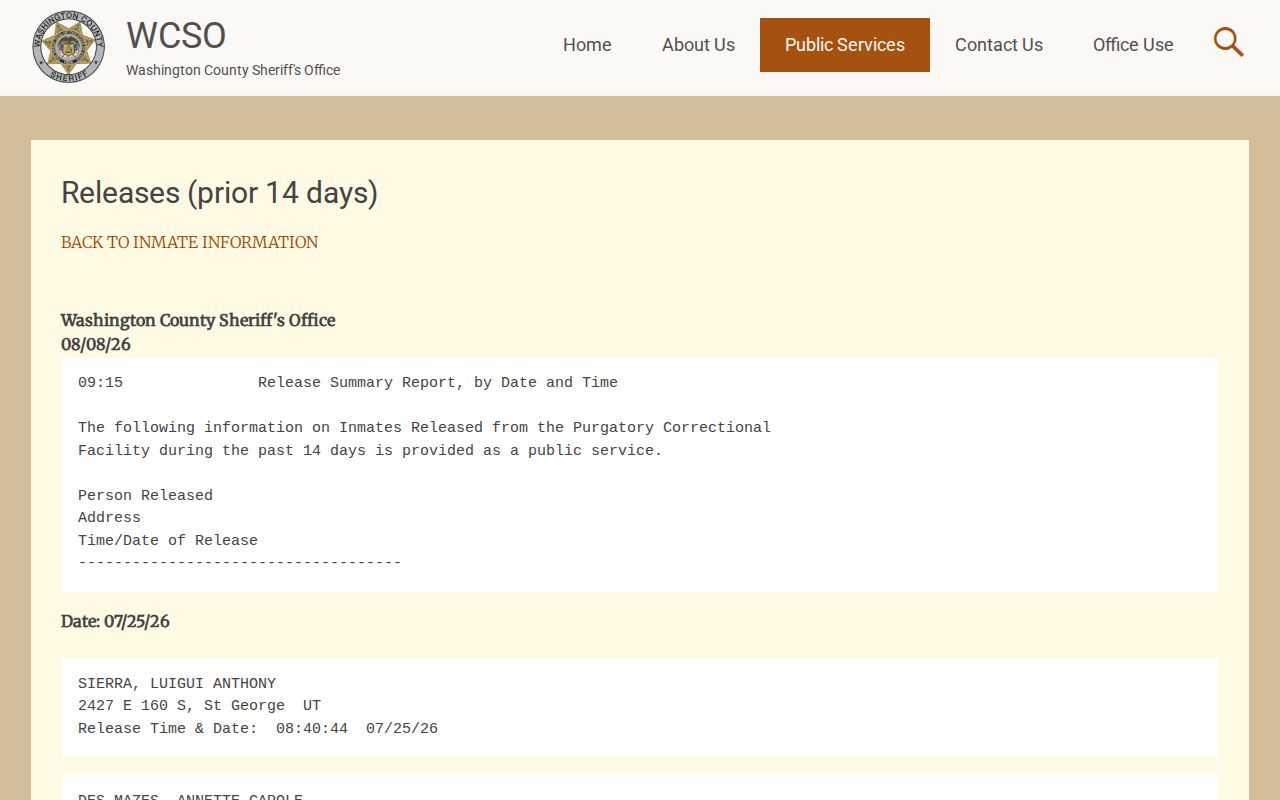
The report proves release from Purgatory during its rolling window. It does not prove that all custody, charges, or supervision ended. The broader Washington County release search explains how the county, court, UDC, VINE, BOP, and ICE channels fit together.
Purgatory Release Record Fields
The public summary is narrow. It identifies the generating agency, generated date and time, fourteen-day scope, and report order. Its rows contain a name, sensitive address-style field, and release timestamp to the second. Current names and home addresses should not be copied into another publication. The field can also display a category-like clue, yet the Sheriff does not label it a guaranteed destination.
A maintained booking and release record can contain much more. Request the admission date and time, PCF or booking number, arresting agency, charges tied to the episode, actual release date and time, release code or reason, releasing court or agency, and receiving agency if maintained and public. A booking photo must be identified separately. Ask for segregable public parts when another part is private or protected.
Roster absence alone is weaker. A lag, transfer, spelling variant, or different custodian can explain why a name is missing. The timestamped report and targeted record answer a different question than the current list.
Purgatory Records and Contact
The Sheriff contact page lists the facility and office details. Posted contact hours apply to the listed office, not the jail’s continuous custody operations. Release timestamps appear across overnight, morning, afternoon, and evening hours.
Purgatory Correctional Facility750 South 5300 West
Hurricane, UT 84737
(435) 656-6600
Monday-Friday, 8:00 a.m.-5:00 p.m.
comment@washeriff.net
The Sheriff GRAMA form requests the requester’s name, birth date, mailing address, daytime phone, and email, along with the desired record and access basis. For a release episode, give the subject’s full name and aliases, date of birth or PCF number, and approximate booking and release dates. Choose inspection or a copy and request an existing maintained record.
The county says it will respond within ten working days. Most report copies have a five-dollar minimum, while inspection of a public record is free. No prepayment is requested. Payment instructions follow by email, and unusual search or compilation work may add charges. The form itself can be reviewed here:
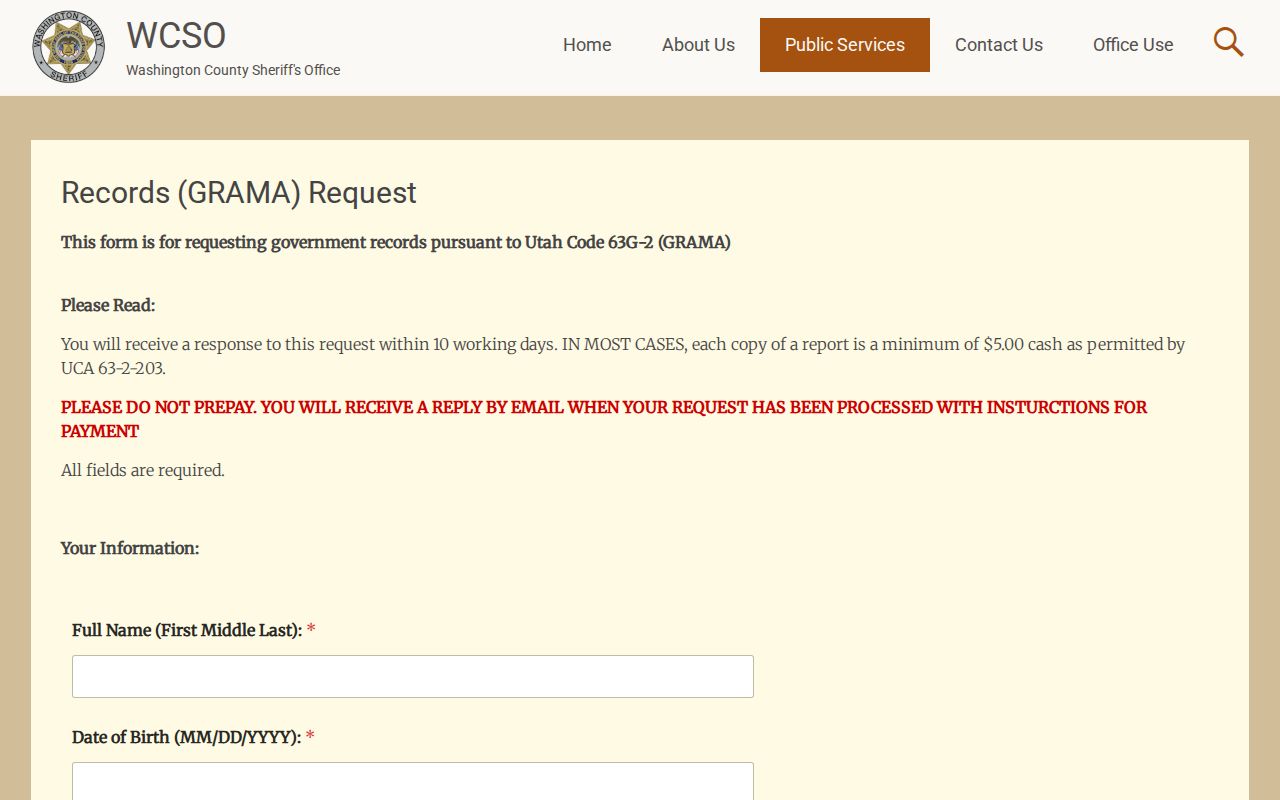
The image helps requesters describe the record in the form the Sheriff maintains, which is more useful than asking for a custom release analysis.
Purgatory State Placement Role
Purgatory is not a state prison. It is an adult county jail with a documented state-contract role. The UDC Inmate Placement Program lists Washington County as a participating county. That arrangement explains why a UDC inmate can be physically housed at PCF while the Utah Board of Pardons and Parole and UDC retain release authority.
An April 2025 UDC booklet listed 506 total Washington County jail beds, 200 contracted, and 100 then available to Corrections, with male housing. These figures describe the program at that publication date. They are not a live count, a guarantee of present capacity, or proof that a named person was in a state bed.
That state-contract role sits beside the county’s separate workers’ housing project. One fact concerns legal placement under UDC; the other concerns a low-security county facility. Together they show why the physical building cannot, by itself, identify who had release authority.
The official program capture gives visual context:
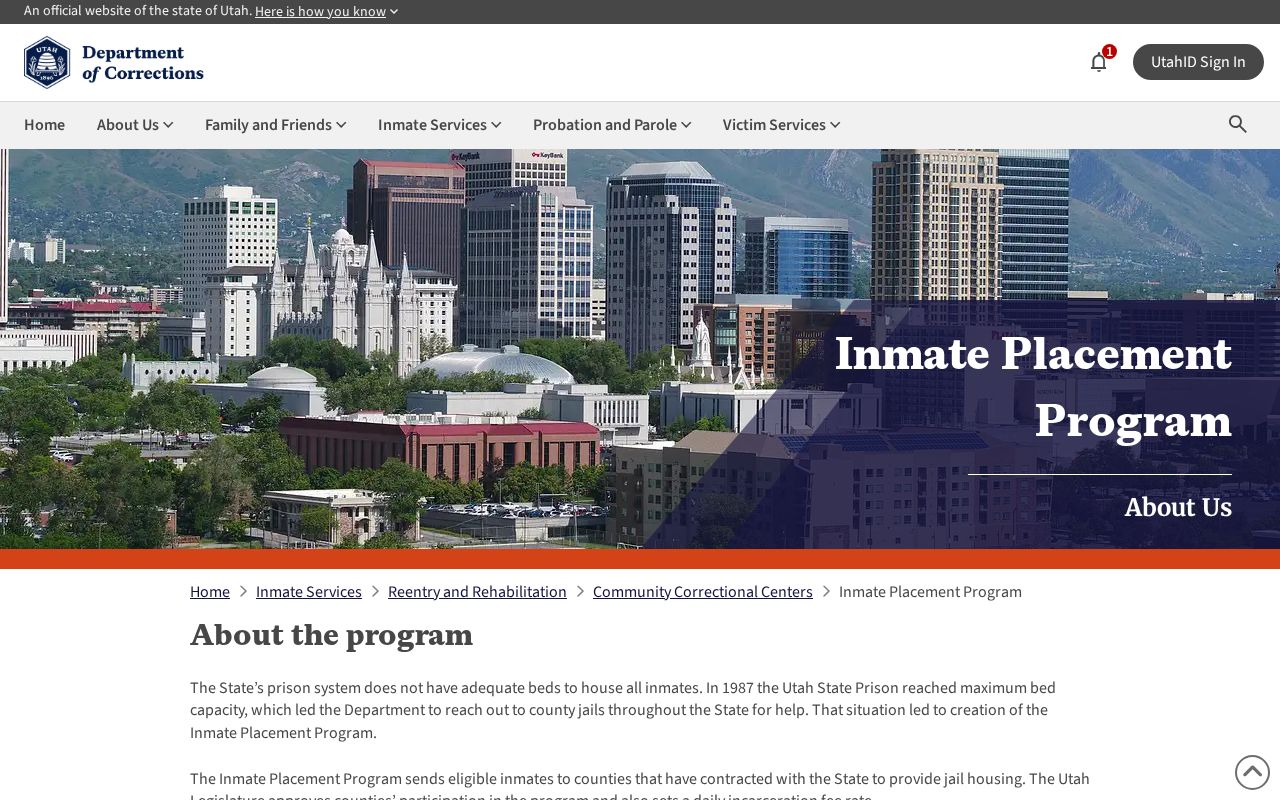
If the booking or release report suggests state placement, search UDC by offender number or full name. Read location, housing facility, and the exact “Release Date and Type” field. A county-jail departure can be a state transfer, not parole or discharge.
Purgatory Detainers and Transfers
Official PCF records make interagency handoffs a core Washington County issue. “UDOC” or “STATE INMATE” directs the next check to UDC. An ICE detainee or hold clue directs it to the ICE Online Detainee Locator. The locator can search by an exact A-number and country of birth, or by exact name with birth details. ICE says its public system includes many current detainees and people released from ICE custody during a limited recent window.
A Purgatory release timestamp and a later ICE result establish separate events. Neither should be rewritten as the other. Locator data can also lag or omit a person for safety, security, or other reasons. When the online result is absent, use the official ICE information line or the appropriate ERO channel.
Federal custody has another split. The BOP locator covers sentenced federal prisoners, but many U.S. Marshals Service pretrial detainees are held in contract facilities without appearing as BOP prisoners. In that situation, the federal docket, lodging facility, and USMS district contact form the correct path. Absence from BOP is not release proof.
Note: A transfer ends Purgatory’s custody entry but does not end incarceration, a sentence, an immigration case, or post-release supervision.
Purgatory Release Logistics
No official source identified a standard exit door, family waiting area, property-return desk, transportation service, routine release hour, holiday procedure, or average processing duration. The public report shows actual events at many times of day. That evidence rules out a claim that Purgatory uses one public daily release batch, but it cannot predict when one person will leave.
Call the facility for case-specific logistics. The posted contact window is useful for office questions, while detention and release work continue outside that schedule. Bail payment also is not final release confirmation. Payment may begin processing, but another hold, a court condition, identity work, or an agency handoff can remain.
- Release
- The end of PCF custody, whether to the community or another agency.
- Transfer
- A move from one custodian or placement to another.
- Detainer
- A notice that another authority may seek custody.
- Discharge
- The formal end of a sentence or supervision when the controlling agency uses that term.
Purgatory Workers Housing
The Sheriff also operates a low-security workers’ housing component on the Purgatory site. It is a distinct facility type, not another state prison. Temporary leave for authorized work or activity is not final release. The Sheriff’s final release report or maintained record must show when county custody ended.
The county announced that the dedicated building would replace temporary structures used for sixteen years and was designed for about 128 low-risk inmates. That is historical planning information from 2018, not a guaranteed present population or program status. The Workers’ Housing release record explains that program distinction in detail.